
Table of contents
- Introduction
- AirTouch and Balayage: two different techniques to brighten the hair
- What is AirTouch and how is it done
- How balayage works
- AirTouch and Balayage: what are the main differences?
- What result is achieved with AirTouch?
- What effect does balayage give?
- AirTouch or Balayage: which technique to choose?
- How much does a hair consultation cost
- Find the right lightening for your hair
Introduction
Lightening the hair does not necessarily mean completely changing colour. More and more often, the aim is to create brightness, movement and depth, whilst maintaining a harmonious and personalised result. Among the most popular techniques for achieving this effect, we find AirTouch and Balayage, two methods that may seem similar by looking at the final result, but follow different procedures.
The choice between the two should not depend solely on current trends. The natural hair colour, hair texture, cut, desired result and history of previous colour treatments are all factors that a professional takes into account before recommending the most suitable technique.
Let's therefore see what actually changes between AirTouch and Balayage and what results they allow you to achieve.
AirTouch and Balayage: two different techniques to brighten the hair
The common ground is the goal: to create a brighter mane through highlights designed to blend in with the base colour. However, it is the way the sections of hair are selected and worked that distinguishes the two techniques.
He Balayage focuses on a free and personalised distribution of highlights, whilst the’AirTouch use the airflow of the hairdryer while selecting the hair to be treated.
This technical difference influences the shade, the contrast, and the way the colour evolves with regrowth.
What is AirTouch and how is it done
AirTouch is an advanced colouring technique characterised by a very precise procedure. The hairdresser divides the hair into sections and uses a hairdryer's airstream to separate the shorter hairs within the section from the longer ones that will be treated subsequently.
The selected lengths can then be lightened in accordance with a colour plan tailored to the individual’s features.
The AirTouch’s greatest strength is its ability to create extremely smooth colour transitions. The natural colour and the lightened sections blend together without creating any overly sharp lines, giving the hair depth and a particularly subtle, blended effect.
It is a process that requires precision and careful sectioning, which is why the initial consultation and the colorist's experience are essential.
How balayage works
He Balayage It is now one of the best-known hair-lightening techniques. The term comes from French and refers to the action of “brushing”: the colour is, in fact, applied to the strands in a carefully calculated manner to create personalised highlights.
Compared to a uniform colour, it allows you to play more with volumes, contrasts and brightness. The lightening can be concentrated around the face, along the lengths or at the ends, depending on the effect you want to achieve.
Therefore, there is not just one Balayage. Intensity, placement and tone change depending on the natural colour, the cut and the desired result.
AirTouch and Balayage: what are the main differences?
The most obvious difference between AirTouch and Balayage It's about the method used to build the lightening.
In AirTouch, the jet of air is used to separate part of the hair from the section before applying the product. In Balayage, on the other hand, it is the colourist who directly chooses where and how to distribute the lightening.
Creative possibilities also change. AirTouch is often chosen when looking for a very delicate fusion between natural colour and lightened hair. Balayage, on the other hand, offers great freedom in creating highlights and can be modulated to achieve subtle or more striking results.
In both cases there is no pre-set shade: blonde, beige, honey, caramel and cooler tones can be adapted to the base and skin tone.
What result is achieved with AirTouch?
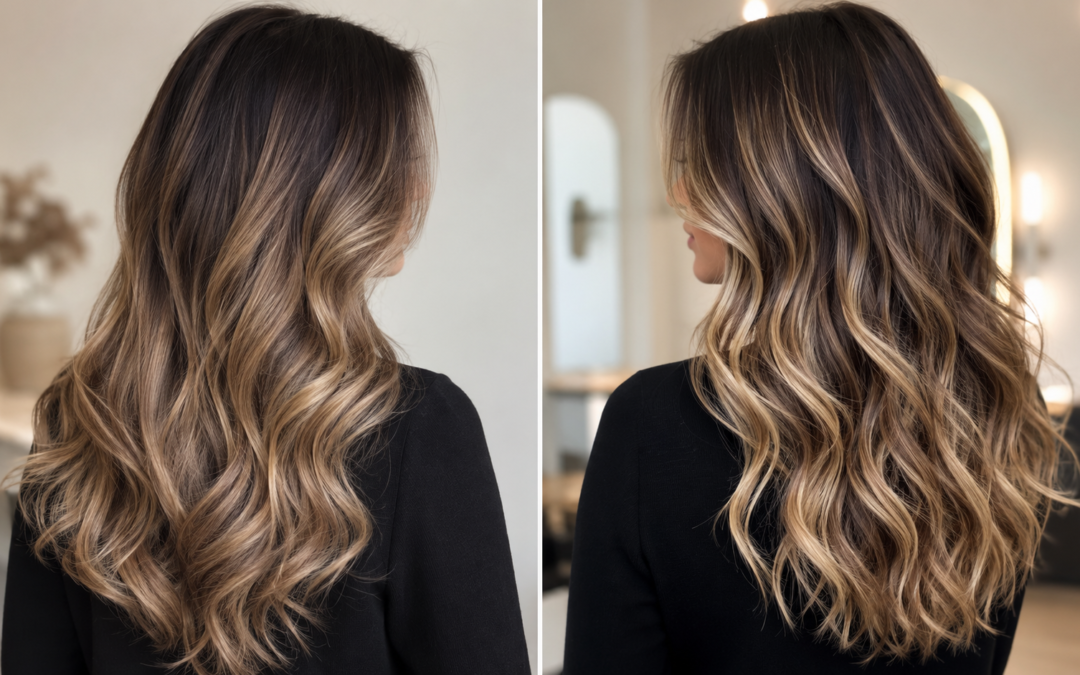
The AirTouch effect is particularly appreciated by those who want a colour subtle, bright and without overly sharp contrasts.
The transition from the natural base to the lighter lengths can be very gradual, creating a multidimensional head of hair. Hair growth also tends to blend harmoniously into the overall colour design.
This doesn't mean, however, that the result has to be very light: the technique can be customised based on the base colour and the level of lightening compatible with the hair.
What effect does balayage give?
Balayage is ideal for enhancing hair movement through strategically placed highlights.
It can recreate a natural effect similar to that of sun-kissed hair or become more defined, with the lengths and ends more heavily highlighted. The strands framing the face can also be emphasised to highlight features and cut.
It is precisely this versatility that makes balayage suitable for a wide range of styles.
AirTouch or Balayage: which technique to choose?
There is no one-size-fits-all answer. Before choosing between AirTouch and Balayage, it is important to understand what sort of result you are looking for and, above all, to assess the actual condition of your hair.
When AirTouch may be indicated
AirTouch can be interesting for those looking for very soft tones, precisely distributed brightness and a delicate transition between the natural base and the lightened sections.
It is particularly recommended when the aim is to achieve a sophisticated and multidimensional colour, avoiding overly obvious visual contrasts.
When to choose Balayage
Balayage can be the ideal choice when you want to freely customise the placement of the lighter areas, concentrating them for example on the lengths, the ends or around the face.
It also allows you to easily adjust the contrast: from barely perceptible reflections to more pronounced lighting effects.
How much does a hair consultation cost
A photograph can be a great starting point, but it shouldn't become a template to be replicated identically. In fact, the exact same colour can look completely different on two people.
Before lightening, it is important to analyse starting colour, porosity, thickness, length, previous treatments and condition of the hair. Only after this assessment is it possible to determine the most suitable technique, tone and intensity.
The true result of quality therefore stems from personalisation, not simply the name of the chosen technique.
Find the right lightening for your hair
Don't just choose a lightning treatment you've seen online: choose one designed for you!
We look forward to seeing you at 25 Corso Buenos Aires, 20124!